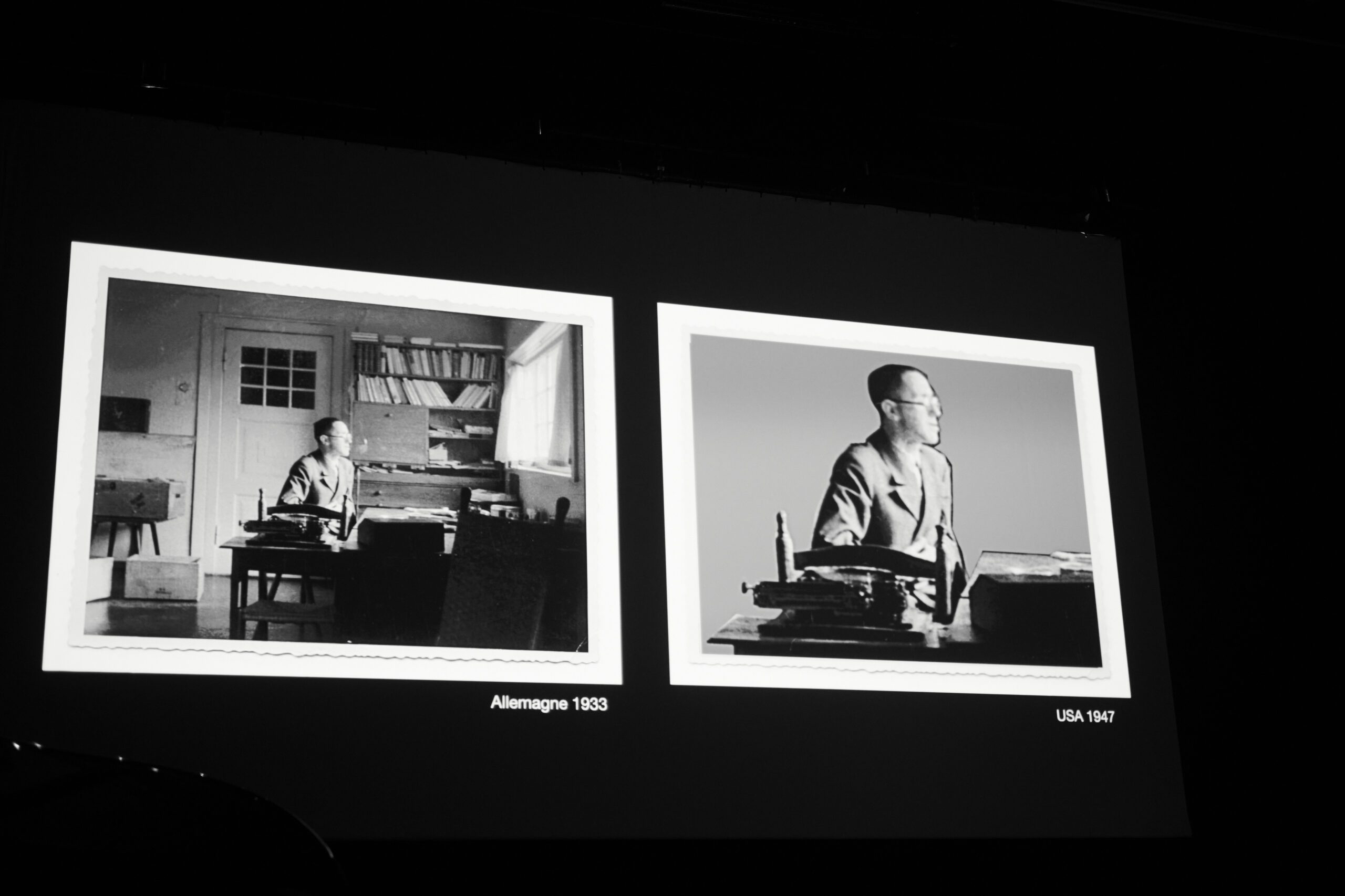
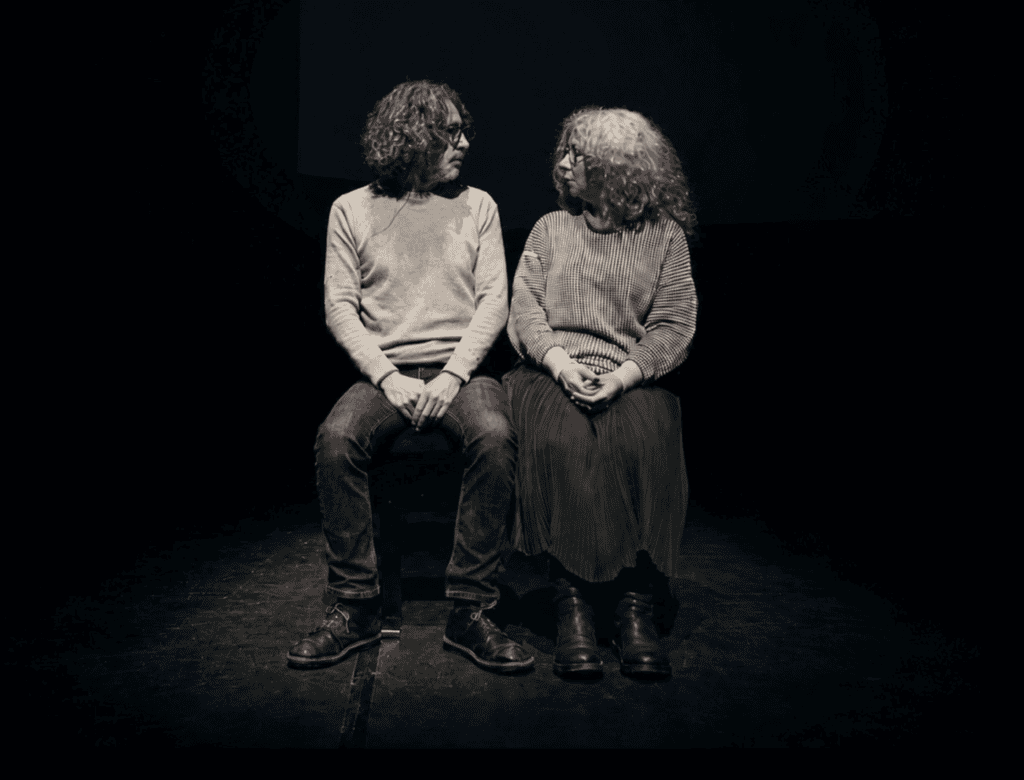
Rabih Mroué and Lina Majdalanie are bringing Bertold Brecht’s HUAC testimony to NYU. What will we see in their performance and what resonances will they find on our campus?
Brecht’s encounter with the spectacle of postwar American fascism unfolded as a pit-fight between poet and politician, waged over the twisting of words in and out of translation. His inquisitors grilled him for his language, poems and lyrics written to accompany scores by Hanns Eisler, who had been unwittingly praised by the HUAC as “the Karl Marx of Communism in the musical field.” Brecht’s cautiously defiant performance reminds us of the vulnerable status of the immigrant and of the precarity of their right to wield language freely. Brecht claimed he answered the HUAC’s questions because as an immigrant he was not entitled to constitutional protections. Was he wrong? These questions have come to the fore under the Trump regime’s campaigns of political violence and censorship. In 2025, a judge ruled that the Trump administration violated the constitutional rights of noncitizens by threatening to punish their Palestine advocacy with deportation. After all, the judge noted, the first amendment reads, “Congress shall make no law…abridging the freedom of speech.” “‘No law’ means ‘no law,’” he ruled in AAUP vs Rubio. But the fact of his needing to assert this in 2025 speaks to the vulnerability of immigrant speech rights rather than to their flourishing.
Many elements of Brecht’s famous show trial are echoed in the relatively obscure stories of three NYU faculty members who ran afoul of the postwar anticommunist machinery and were persecuted for their politics by the government and the university alike. Over the last year, a group of students and I have been researching these bygone colleagues; on November 5, we are mounting an exhibit about them, The Red and the Violet, at the Espacio de Culturas gallery. Lyman Bradley, the chair of NYU’s German department, was hauled before the HUAC in 1946 for his activism with the Joint Anti-Fascist Refugee Committee, an organization that resettled people fleeing Franco’s Spain. When the JAFRC refused to hand over their records to HUAC, its board was convicted of contempt of Congress. Bradley served his time in a West Virginia federal penitentiary, sharing a cell with the novelist Howard Fast. While Bradley ran the prison library, NYU administrators colluded with the FBI to fire him upon his return to New York. Thanks to research by historian Phillip Deery, we know that NYU chancellor (i.e. president) James Madden personally ensured J. Edgar Hoover he would “clean up the campus as much as possible…cutting off the staff any professors who might be of a suspicious or subversive category.”
NYU English professor Margaret Schlauch’s story, like Brecht’s, foregrounds the relations between exile, fascism, and language. Faced with the inevitability of a career-ending congressional subpoena in early 1951, Schlauch, a scholar of medieval literature and languages, packed two suitcases and irrevocably crossed the Iron Curtain into Poland. There she took up a post at Warsaw University, where she helped to found their English department and continued her distinguished career as a philologist. Schlauch died in Poland in 1986. Having been in Munich for research during Hitler’s failed 1923 Beer Hall Putsch, Schlauch’s writings portray an exilic figure whose study of ancient languages was deeply affected by the dislocations of modern fascism. After returning home from Munich, she told a friend, she “felt more of a wanderer and an exile in my native land than ever.” In 1927 Schlauch published her first book, a study of Chaucer’s sources for the tale of Constance, a queen twice wrongfully accused of heinous crimes and twice sent into exile.
It is fitting that the philologist, the lover of words, would be banished alongside the poet. Brecht wrote that “it is incorrect to say that German literature accomplished an exodus in toto. It is correct to say that literature was driven out of the German people.” Censorship, the political persecution of speech, deprives a culture of its language, exiling its words. Neither Schlauch nor Brecht found homes where they could speak freely. Schlauch remained aware that her letters to New York were being read by Polish and American authorities alike. “As I sat…listening to a pre-May Day rally,” Schlauch wrote from Warsaw in 1951, “I thought how familiar were the themes: the struggle for peace, the condemnation of fascism, the dedications to a better future…I thought back over rallies in New York during the years of hunger and unemployment, during the Spanish Civil War and the period of Munich, during the rise of postwar reaction and the fight against our reactionary Tafts and Hartleys, McCarthys and McCarrans, Deweys and Dulluses…And my ears caught many familiar phrases, familiar to me though now expressed in Polish…I thought to myself: you have changed the scene but not the basic struggle in which you are engaged. When a delegation of students invites me to make a statement on the current Peace Plebiscite, I almost think I hear remembered voices asking me to speak at a peace rally in Washington Square Park in New York.”
Zachary Samalin is Associate Professor of English at NYU.
- Thu Oct 22 – Sat Oct 24
Rabih Mroué & Lina Majdalanie: Four Walls and a Roof
What the artist tells the state.
- NORTH AMERICAN PREMIERE
- Political Theater