A WITCHING HOUR
Life’s but a walking shadow, a poor player,
That struts and frets his hour upon the stage …
William Shakespeare, Macbeth (V, 5)
Czech poet Vladimír Holan begins his masterpiece, “A Night with Hamlet” (1964), with an extraordinary claim: “The yielding ripeness of Shakespeare invites license.” I, who “collect” variants of Hamlet, am deeply moved by his claim, as I had once imagined creating a version of Hamlet for three pebble – white, black, transparent – and I have also written a micro-miniature version of the play from the point of view of the dead Ophelia, Ophelia’s Lament. While Hamlet is certainly the most reinvented, subverted, perverted of Shakespeare’s plays, there are numerous others that have been radically transformed, the most famous probably being Romeo and Juliette recreated as West Side Story; the most ludicrous, The Tempest restaged as the film Forbidden Planet; and the most horrific, Carmelo Bene’s extraordinary Macbeth Horror Suite. In Holan’s nightlong conversation with Hamlet, the Danish king strays far from the traditional plot as he interacts with Juliet, Orpheus, and Eurydice, so by comparison we should have no problem with something as unobjectionable as the arrival of a fourth witch in Macbeth.
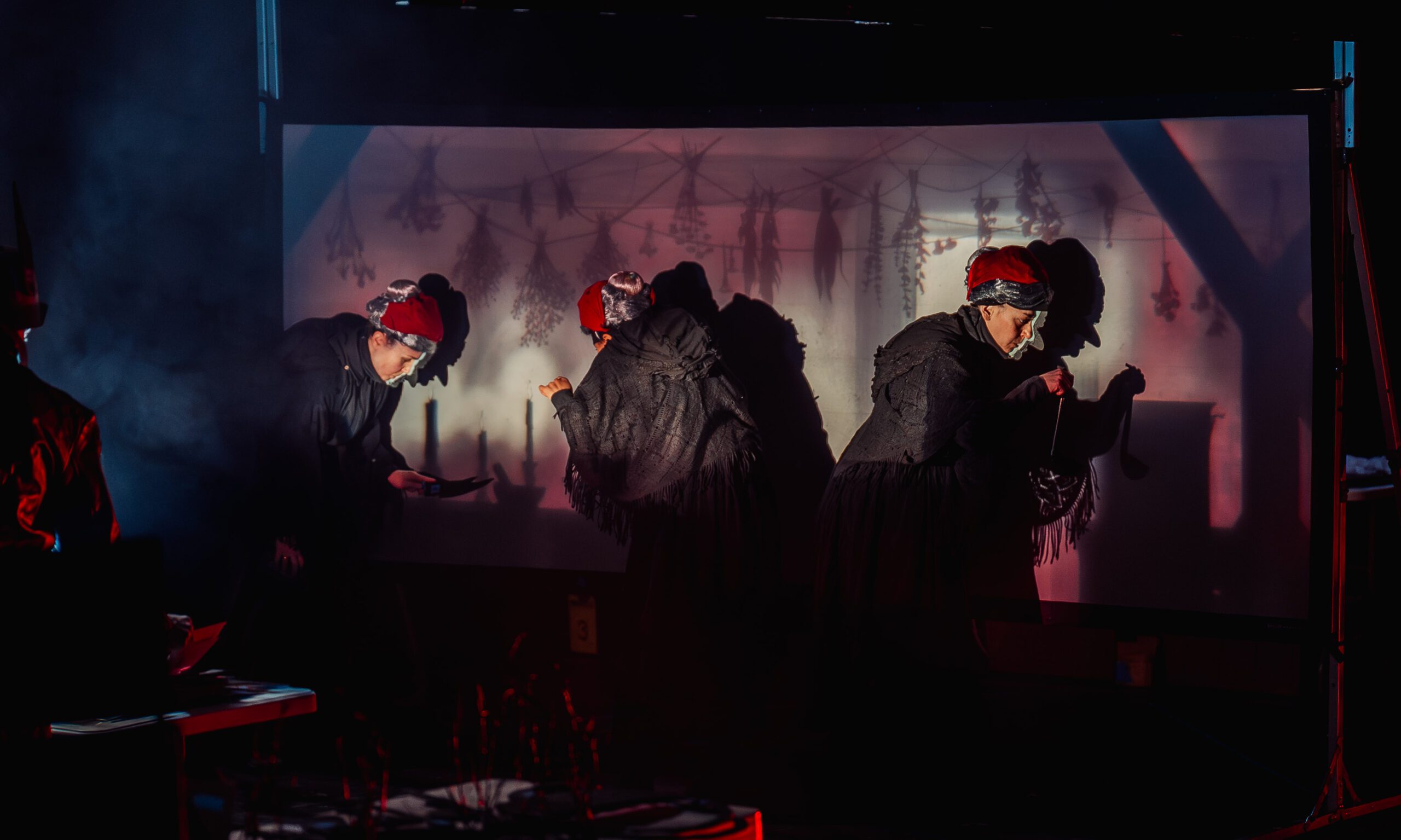
Manual Cinema’s The 4th Witch is a multimedia production, spanning the dichotomies of cinema and theater, literature and performance, dreamtime and diurnal reality. Its relatively simple technology is activated by virtuosic live animation using both on-stage shadows and projected cutout forms to create a hybrid shadow marionette theater. The shadows cast by the simple cutout figures are no less compelling than those projected by the live actors, such that Manual Cinema realizes Antonin Artaud’s dream, famously expressed in The Theater and Its Double, of transfiguring the human body into a sort of hieroglyph, so that signs and bodies exist on the same ontological level. Manual Cinema accomplishes this live, onstage, right before our eyes. The stage presents four major elements which both attract and divide our attention: a screen upon which live actors cast shadows; four overhead projectors operated onstage that project cutout figures as shadows; a second screen on which the live and cutout shadows are mixed and synchronized via a live feed; and three multi-instrumentalists who provide music, ambient sounds, foley, and speechless vocalizations. The secrets of animation are embodied onstage before our eyes, not as a Brechtian alienation effect, but rather as a form of theatrical prestidigitation, a dramatic wizardry that resonates with the witchery depicted in the tale. This play offers a new form of live performance and storytelling without dialogue, where the visual counterpoint fragments and decenters our attention, all the while intertwining the disparate elements into a subversive modernization of a canonical play.
What child hasn’t held their hands before a lamp or a flashlight to cast wondrous shadows of familiar or otherworldly creatures on the wall? How many children have created their own shadow theaters, where they reinvented classic masterpieces by materializing their own fantasies? One such child was Lotte Reiniger, who revolutionized cinema in the 1920s by adapting to film traditional shadow play inspired by Chinese and Indonesian traditions, by means of a frame-by-frame stop-motion technique she called “silhouette animation.” Though she never produced a shadow-puppet film based on Shakespeare, the English bard played a pivotal role in her imagination, when as a young girl in Berlin she staged his plays as shadow theater in her family’s living room. Her films, synchronized to music but without dialogue, are among the noteworthy precursors to contemporary shadow theater.
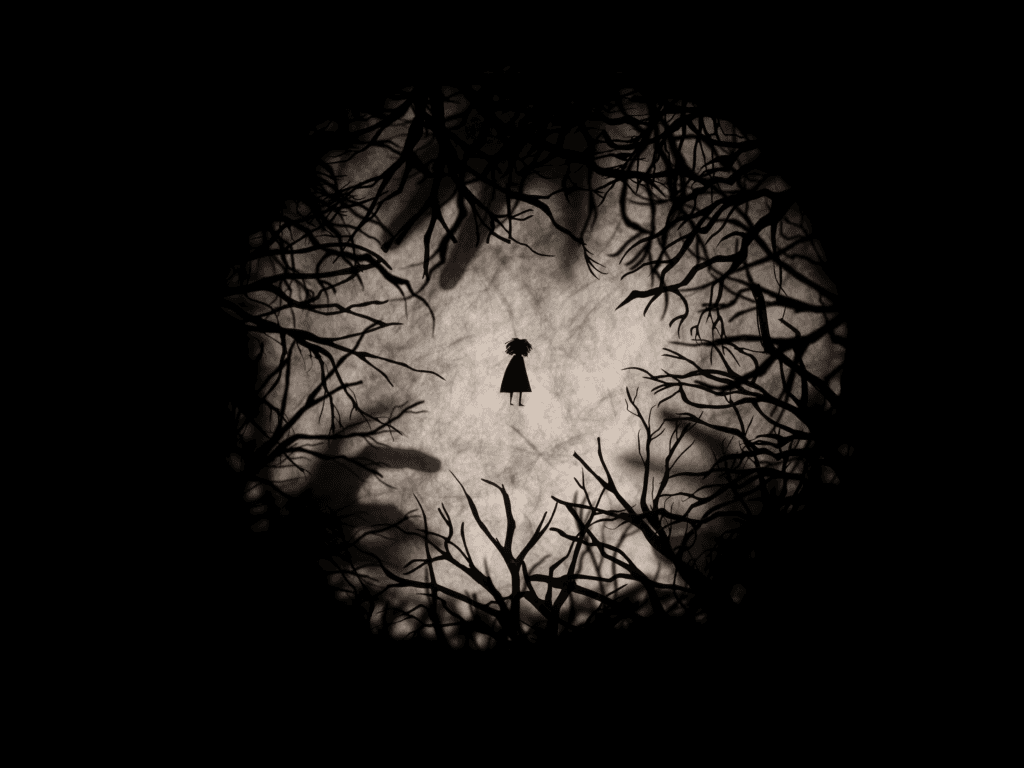
Writing of Macbeth in Shakespeare Our Contemporary (1961), the renowned Shakespeare scholar Jan Kott reminds us that, “History, shown as a mechanism, fascinates by its very terror and inevitability. Whereas nightmare paralyses and terrifies,” all the while insisting that, “there is only one theme in Macbeth: murder.” The 4th Witch is the tale of a little girl, orphaned and exiled during wartime, who becomes an apprentice to three witches inspired by those from Macbeth, with the goal of seeking revenge against the evil king for the murder of her family. It might thus seem odd to consider the tale of a murderous king and a murderous little girl to be charming, but this is the case given the different meanings of the term. It is charming in that the characterization of the girl is delightful, appealing, captivating; charming insofar as a magical spell is cast not just upon the characters, but also upon us, the spectators; and it is also charming because it is enchanting – literally performing magic by chanting, singing a spell upon someone – as experienced through the live musical accompaniment.
Enchantment is bewitchery. In Macbeth, the three witches, appropriately called the Weird Sisters, are as memorable as the King. Through their mysterious incantations and equivocal prophecies they are sowers of chaos and agents of destiny (wyrd = fate or chance). They are the nightmare that terrifies, as Kott would say, and it is precisely their obscurity and equivocation, their eeriness and weirdness, that makes of historical inevitability a labyrinth, from which Macbeth tries to murder his way out. It is precisely a fourth witch who is needed in order to clarify the situation by directly intervening in the inexorable dialectic of history. Jan Kott, who lived through the horrors of the Second World War first as soldier then as partisan, read Shakespeare through the lens of modern totalitarian violence and existential angst, thus making of Shakespeare “our contemporary.” Manual Cinema’s The 4th Witch brings Macbeth into the early 20th century, close enough to our time to offer a sense of reality, but just far enough away to have the feel of myth or fairy tale. The 4th Witch doesn’t so much present a modern version of Macbeth as it intersects with a Macbeth of the modern imagination, situated between magical realism and nightmarish fantasy.
The ripeness of Shakespeare has indeed engendered new tales, turning Hamlet and Macbeth inside out by featuring Ophelia and Lady Macbeth, and by inspiring the appearance of a fourth witch. We may imagine many others. Perhaps the time has come for that other witch, Sycorax – an obscure creature in The Tempest whose powers are so great that she can control the moon and the tides – to have her hour in the spotlight, or for Hecate, the ancient Greek goddess of witchcraft who briefly appears in Macbeth, to play the lead. Meanwhile, we shall continue to be spellbound by the sabbath of the fourth witch.
Allen S. Weiss teaches in the Departments of Performance Studies and Cinema Studies at New York University.
- Thu Oct 15 – Sat Oct 17, 2026
Manual Cinema: The 4th Witch
Something wicked this way comes.
- Theater
- NYC Premiere