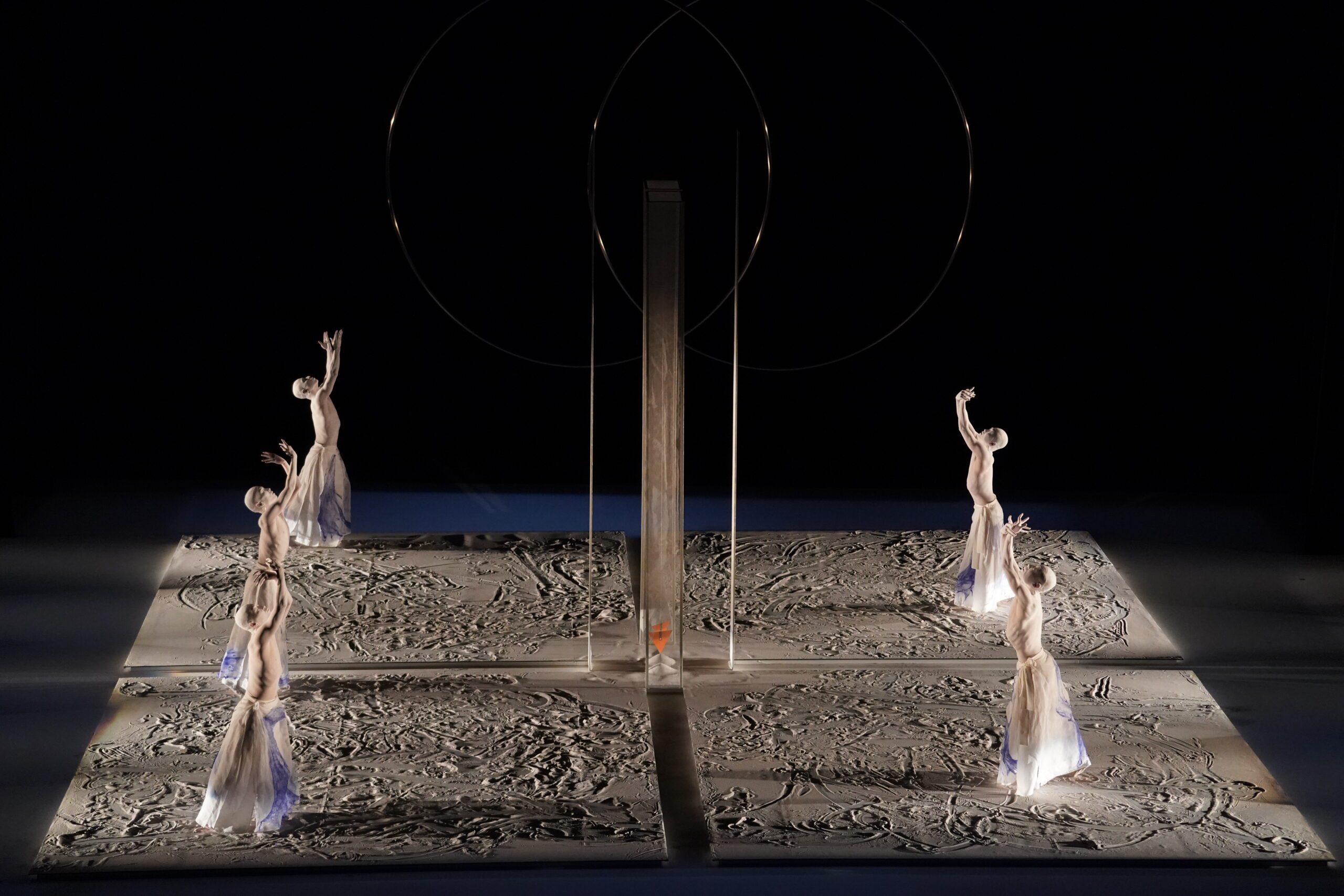
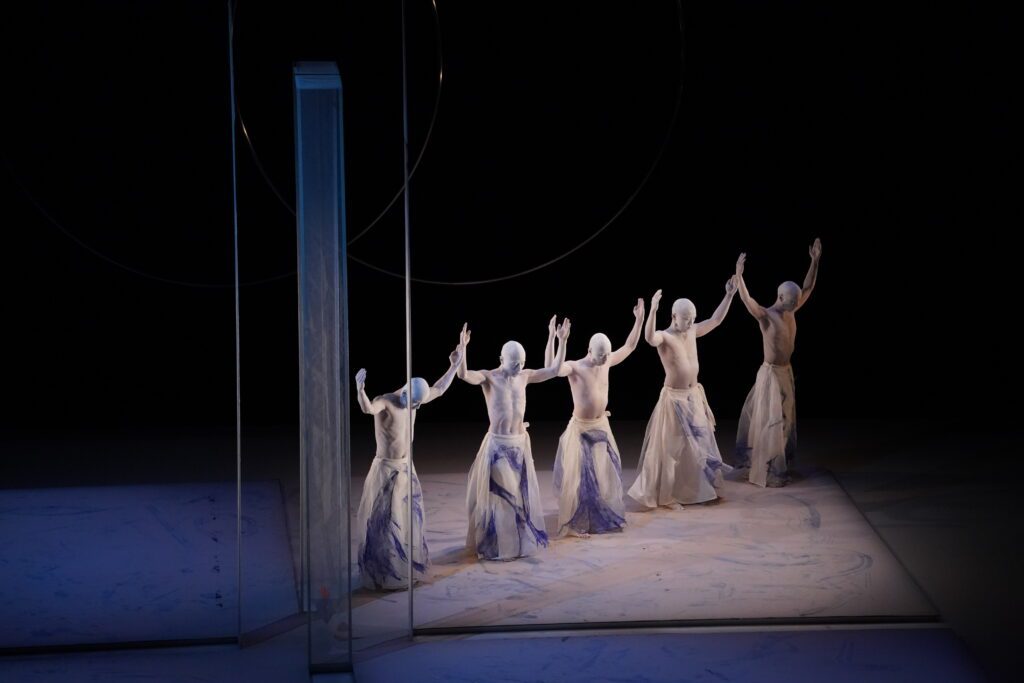
This is in a number of ways an historic performance. SankaiJuku is one of the best-known of the butoh troupes, and has performed globally and continuously since 1975. With the passing of its founder, Ushio Amagatsu, in 2024, this is not only his last work but likely the final tour of the group itself.
But it is also extremely timely. The diverse practices that make up butoh really took form in the 1960’s, at a time when Japan was undergoing radical political upheaval, and the last refuge of anything like an effective politics seemed to reside in art and aesthetic form; this was the ground of butoh’s force. The underlying assumption of this moment was that traditional politics no longer worked; a more fundamental rethinking and reworking of the human would perhaps be the only effective approach.
And so the bodies in butoh, as well as the movement, sets, and themes, all point to only the barest elements of humanity. In many ways, butoh’s body is at once prehuman and posthuman. The contemporary Taiwanese artist, Li Yi-Fan, in a recent performance in New York said that his posthuman machinima-based digital figures are directly patterned after butoh dancers.
These are, though, dark figures (the full name, Ankoku Butoh, typically is translated as the “Dance of Darkness”), and leave one uncertain whether there is any evident hope. The founder of SankaiJuku, Amagatsu, equated his performance to the Japanese mythological Sun Goddess, Amaterasu. She dwelled in the darkness of an enclosed cave, only to be enticed out—bringing light and life to the world—via a dance. Butoh would seem to be patterned on that boundary, between a world not yet really formed at all—a world of unlimited potential—and a world quickly falling into political strife.
Butoh’s dance with the barest elements of the world—gravity, etc.—engage the world, but then dance on that border between the world, and a reattachment to the “human” bounds of gender, culture, and politics.
Thomas Looser is Associate Professor of East Asian Studies at NYU.
- Thu Nov 5 – Sat Nov 7
Sankai Juku: TOTEM—Void and Height
The final work of a singular visionary.
- Dance
- Butoh
- International
- NORTH AMERICAN PREMIERE