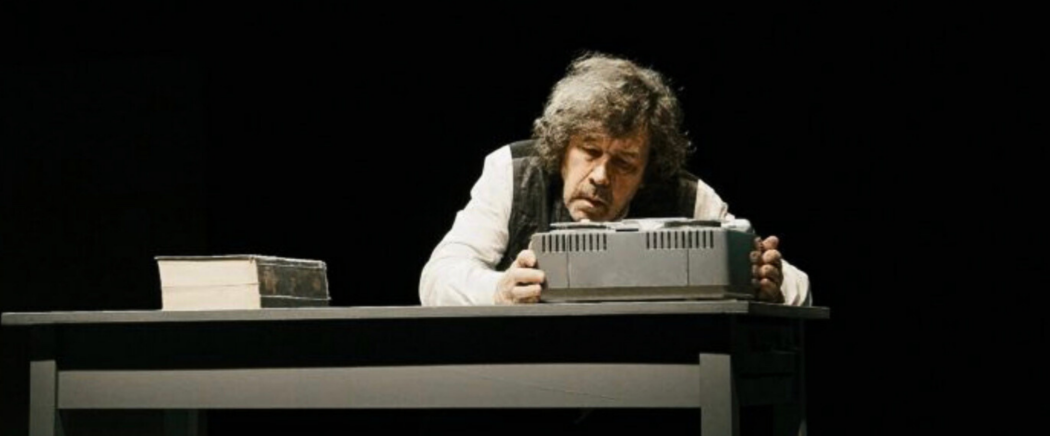
Seventy years after its creation, how should we understand Krapp’s Last Tape, which depicts an elderly man listening to his past recordings: a drama of old age, a metaphysical meditation on the passing of time, an allegory of our apocalyptic world? Beckett always rejected symbolic interpretations of his works. Each person has their own understanding, depending on their culture. In French theatres, a deathly silence reigns in the face of such depressed characters, overwhelmed by the absurd fate of humanity. In English-speaking theatres, there is a lot of laughter as the audience recognizes the humor that inspires the zany gestures and puns. Buster Keaton inspired Beckett as much as the philosophers of the Early modern age. In Krapp’s Last Tape, the character discusses life while stuffing a banana into his mouth. Half sad clown, half metaphysical bum, he is associated with rubbish and crap. Beckett doubles the joke of the English title with the French title, La Dernière Bande, which refers to a reel of recorded tape but also to sexual arousal, a questioning for the old man. Beckett is one of the few bilingual authors in literature, and he takes obvious pleasure in using salacious expressions specific to each of the two languages.
However, the main character in this play is perhaps not Krapp, but the tape recorder he manipulates, which plays back his voice from the past. In the 1950s, this device became widely available and appeared on theatre stages and in films. Everyone could then record others and listen to themselves, with the curiosity of not completely recognizing their voice. The fake dialogue between Krapp and the tape recorder is extraordinarily modern when we consider our current behavior with artificial intelligence, which has become a major interlocutor. The speaker who fed the device with his words is now a listener. At the end of the play, the tape recorder has the last word, humanity having become nothing more than an ear.
The protocol of the ending is undoubtedly the essential feature of Beckettian theatre. How to end? That is the big question, even if nothing ever ends. Beckett highlights the decrease, the least, the worst, while preserving the remnants, the dead voices, and the memories. Many things now lie in the trash bins, and it matters little whether they are dead or dying: Humanity with a capital H, planet Earth, the hope for a better Tomorrow, the identities of the Self. Krapp observes: “Just been listening to that stupid bastard I took myself for thirsty years ago, hard to believe I was ever as bad as that. Thank God that’s all done with anyway.” All that remains is the grain of voice and the specter of aborted fictions. Modernists have historically proclaimed the end of the old world and the beginning of the New. Beckett, more singularly, has continued to question the remainder, even if it is greatly diminished and whispered. That is why he remains our contemporary.
François Noudelmann is Professor of French Literature, Thought and Culture and Director of La Maison Française of NYU.