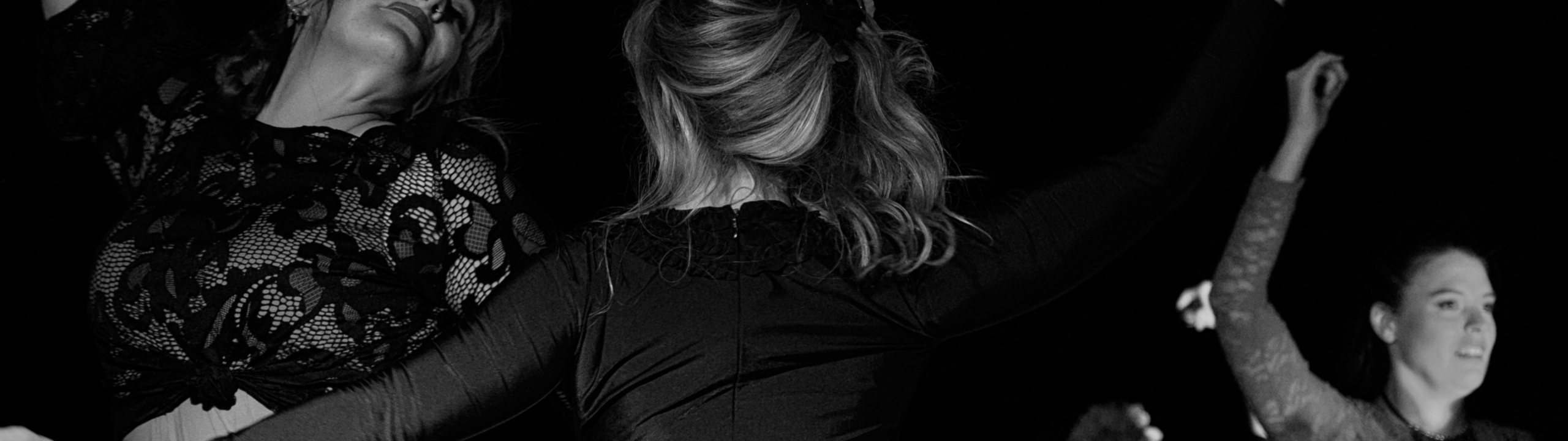
Dance is a form of language, a grammar of the body. As a former dancer-turned-writer-turned teacher of creative writing, scratch beneath the surface of my work, and you’ll find dance. When I write—and likewise when I teach writing—I am drawing upon lessons I learned as a dancer, lessons about technique, structure, pacing, rhythm, flow, articulation and clarity. When charting out a short story or a novel—feeling or intuiting the structure, the flow of sections, the blocks of text on the page—I often visualize the order and then work to create purposeful patterns, motifs, allusions and a through-line, as if performing a work of choreography. I think about transitions and try to articulate and aim for clarity. I write towards what feels like truth or verisimilitude, as I used to work as a dancer with the floor. I practice rhythm and pacing. I rework passages, tweaking and fine-tuning. I seek out a certain tone or quality of execution. And always there is the need to rewrite and revise—or practice, practice, practice—to find the right tone of voice, turn of phrase, much like what it is to rework a phrase of movement.
In my Gallatin Advanced Writing course, “Writing the Portrait: Depicting Artists in Fiction,” we examine how writers of fiction explore the world of the artist working in various disciplines—music, theater, visual art, film, photography and, of course, dance. For our weeks on dance, we read Lorrie Moore’s short story, “Dance in America” which begins with a kind of artistic manifesto:
I tell them dance begins when a moment of hurt combines with a moment of boredom. I tell them it’s the body’s reaching, bringing air to itself. I tell them that it’s the heart’s triumph, the victory speech of the feet, the refinement of animal lunge and flight, the purest metaphor of tribe and self. It’s life flipping death the bird. (Moore, “Dance in America” in Birds of America)
We read Moore’s story alongside the modern dance pioneers’ actual artistic manifestos: Isadora Duncan’s “The Dance of the Future,” in which she writes that the dancer of the future, “…will dance not in the form of nymph, nor fairy, nor coquette, but in the form of a woman in her greatest and purest expression” and Martha Graham’s “A Modern Dancer’s Primer for Action” in which her thoughts on the purpose of technique still resonate, “Technique is a means to an end,” she argues, “It is the means to becoming a dancer.” We also read Colum McCann’s prismatic portrait of Rudolph Nureyev, Dancer, which includes multiple voices, varying points of view and different modes of storytelling (letters, diaries, artist’s notes and catalogues of the items of tribute and adoration thrown onstage after a Nureyev performance at the Palais Garnier in Paris and his possessions auctioned off after his death) offering a rich and textured portrait of an enigmatic, larger-than-life dancer, performer, human. In each of these works we discuss story and novel structure, note pacing and motifs and how each writer has incorporated some aspect of dance into the very language. We also read Zadie Smith’s thought-provoking essay “Dance Lessons for Writers,” putting into practice the question she posits, “What can an art of words take from the art that needs none?” It’s a question that, even before I read Smith’s essay, has guided my own writing and teaching and led me full circle back to dance, first in writing a novel about dance, An American Dancer, which follows the life of a chorus hall dancer as she finds agency dancing in fin-de-siecle Paris at the Folies-Bergère as the new modern dance forms come into being, and, second, in the dance studio, where I find myself on Tuesday and Sunday afternoons practicing technique, articulation and clarity, rhythm and pacing, and where I hope to find what dance can continue to teach me about writing.
Vanessa Manko teaches Creative Writing in NYU Gallatin.